Dog's Ear Gunk Brown and Smelly: What's Causing It
Brown, smelly ear discharge in dogs typically points to yeast or bacterial overgrowth — and underlying allergy is the most common driver. Here's what to ask the vet.
By Gary — 7+ years managing my Cockapoo's food allergies. Sources cited below.
9 min read
Affiliate disclosure: Some links here are affiliate links — buying through them keeps the scanner free for everyone, at no cost to you.
By Gary, founder of Pet Allergy Scanner. 7+ years managing pet food allergies with my Cockapoo.
I earn a small commission from purchases through affiliate links in this article. This helps maintain the free scanner tool and costs you nothing extra.
Last Updated: May 2026
Quick Answer: A single brown, smelly ear can be a one-off infection. Ears that keep going brown and smelly month after month are almost always telling you something larger is going on. Mueller et al.'s 2016 case-series synthesis described allergy as the underlying mechanism in the substantial majority of recurring otitis cases. The investigation pathway moves from cytology and topical treatment to an elimination diet trial when allergy is suspected. Use our free scanner to audit current food during the trial.
What Brown Smelly Discharge Actually Is
Healthy ears produce small amounts of pale wax that you may notice as a faint amber or light brown smudge on the visible skin. The "gunk" most owners describe — the dark brown, sometimes greasy, distinctly yeasty-smelling material — is different. It represents accumulated cellular debris, exudate, and microbial growth.
The Merck Veterinary Manual describes the spectrum of canine otitis externa as ranging from mild ceruminous (waxy) through purulent (pus-forming) presentations. Brown, smelly material sits at the ceruminous end, typically dominated by:
- Malassezia pachydermatis — a normal commensal yeast that overgrows when ear conditions favour it.
- Cocci or rods (Staphylococcus, Streptococcus, Pseudomonas) — secondary bacterial colonisation.
- A mixture of the two — common in chronic, untreated cases.
The smell owners describe most often is "sweet, musty, like off-bread" — that is yeast. A genuinely foul, almost rotting smell often signals Pseudomonas, which is a different problem requiring different treatment.
Key Takeaways
- One brown, smelly ear can be a one-off infection; ears that keep going brown month after month are usually telling you something larger is going on.
- Mueller et al. (BMC Vet Res 2016) attribute the substantial majority of recurring otitis cases to underlying allergy.
- Cytology + topical antifungal treatment clears each episode, but the cycle only stops when the upstream trigger (most often a food protein or environmental allergen) is identified.
Yeast vs Bacteria: Why Cytology Matters
Malassezia and bacterial otitis can look superficially similar in the ear canal but require different topical preparations. ACVD educational materials and the Merck Veterinary Manual both stress that empirical treatment without cytology is one of the leading causes of treatment failure in canine ear disease. A vet performs cytology by:
- Taking a swab from inside the ear canal.
- Rolling the swab onto a microscope slide.
- Staining and examining for yeast cells (peanut-shaped budding organisms), cocci, rods, neutrophils, or mites.
That five-minute test changes which medication your vet may recommend. It also flags whether bacterial culture and sensitivity testing is needed — particularly if rod-shaped bacteria suggest Pseudomonas, where antibiotic resistance is a documented concern.
The Allergy Connection
Mueller et al.'s 2016 BMC Veterinary Research review and the ACVD consensus on canine atopic dermatitis both identify recurring otitis as a hallmark sign of underlying allergy. Veterinary dermatology textbooks describe the mechanism plainly:
- Allergic inflammation thickens the ear canal lining.
- Wax composition and pH shift, creating a more humid, more nutrient-rich environment.
- Skin barrier function in the canal degrades.
- Yeast and bacteria that normally exist as harmless commensals overgrow.
This is why a course of ear drops resolves the current infection but the same ear is back six weeks later. The drops did their job. They cannot prevent the next overgrowth because the upstream allergy is still inflaming the canal.
Case-series data summarised in Mueller 2016 places the proportion of recurring otitis cases with an underlying allergic component at roughly four out of five — the exact figure varies by study population. The clinical implication is consistent: when ear infections keep coming back, allergy investigation is the rational next step.
The Vet Examination Pathway
A first-visit workup for a brown, smelly ear typically includes (your vet may recommend):
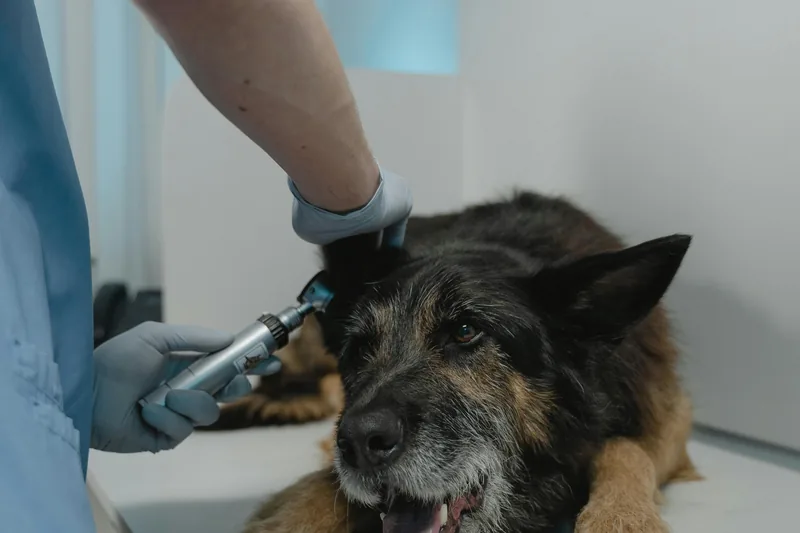
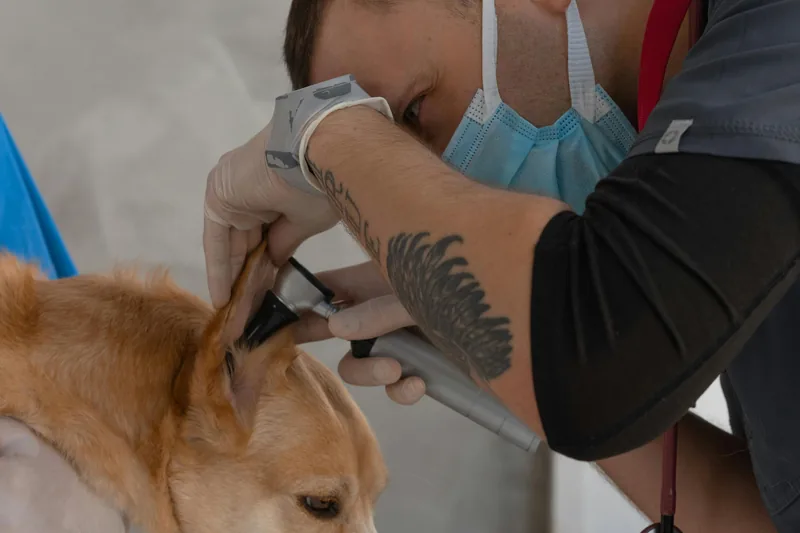
- Otoscopy — visualising the canal and ideally the ear drum. A ruptured drum changes which medications are safe to use.
- Cytology — the slide test described above.
- Bacterial culture and sensitivity — when rods are seen, when pseudomonas is suspected, or when previous treatment has failed.
- History of recurrence — how many episodes, how often, what month, what side, what diet.
- Examination of the rest of the skin — paws, belly, groin — to see if the ear is part of a wider allergic picture.
For dogs with chronic disease, advanced imaging (CT) of the middle ear is sometimes recommended to assess whether infection has tracked deeper. Pendulous-eared, hairy-canalled breeds — Cockapoos very much included — are over-represented in chronic cases.
When Topical Treatment Is Enough
A first or second isolated episode of brown, smelly ear in an otherwise healthy dog is reasonable to manage as straightforward otitis externa. Your vet may recommend:
- A cytology-guided topical preparation.
- Gentle ear cleaning with an appropriate non-irritating cleanser.
- A re-check at 7–14 days to confirm resolution and re-examine the canal.
If the ear clears, the smell goes, and it stays clear for months, you have probably dealt with a self-limiting issue.
When You Need to Investigate Allergy
The threshold for moving beyond topical-only treatment is well-described in dermatology literature: three or more episodes within twelve months, or any episode that fails to clear within standard treatment timelines. At that point your vet may suggest:
- Strict, year-round flea control — fleas drive their own pruritus and can confound assessment.
- An elimination diet trial — 8–12 weeks of a single novel protein or hydrolysed prescription diet, fed exclusively. Mueller et al. (BMC Vet Res 2016) describe this as the most reliable diagnostic for adverse food reactions.
- Atopy workup — intradermal or serological allergy testing for environmental allergens, usually after food has been investigated.
The elimination diet guide on this site covers the realistic mechanics of running a trial in a normal household. The Pet Allergy Scanner is a free tool you can use to check whether the food you are about to put your dog on contains hidden common allergens — useful when you are switching brands as part of a trial.
In my own household, my Cockapoo's ear infections were the first sign anything was wrong (the full backstory of how the diet went from there). They cleared with drops, came back, cleared, came back. The pattern only made sense once we ran a strict elimination diet — and the yeast infection connection became obvious in retrospect. The ear infection symptoms hub covers the full picture if you are still piecing things together.
Ear Cleaning at Home — What Actually Helps
Between vet visits, a sensible cleaning routine reduces recurrence — but the wrong approach makes things worse. The protocol that works:
- Vet-recommended cleaner only — Otoact, EpiOtic Advanced, CleanAural, or vet-formulated alternatives. Avoid surgical spirit, hydrogen peroxide, alcohol, vinegar, and home-mix solutions; they sting on inflamed tissue and damage the canal lining.
- Fill the canal, massage 30 seconds, let the dog shake — the canal is L-shaped, so loose material needs to be brought up by the shake. Wipe the visible debris with cotton wool.
- Cotton buds (Q-tips) are a hard no for the deep canal — they push wax further in and risk damaging the eardrum. The visible outer ear is fine to wipe with cotton wool.
- Dry thoroughly after every clean or after swimming or bathing. Damp canal is yeast paradise.
- Frequency matters — most allergic dogs do well with weekly cleaning during higher-risk periods (humid weather, post-swim, early in a diet trial); over-cleaning irritates the canal lining.
What Each Cycle Costs You
The diagnostic case usually clicks once the per-cycle cost is written down:
| Item | UK | US | |---|---|---| | Vet visit | £45-80 | $60-120 | | Cytology | £20-40 | $40-70 | | Ear drops (10-14 day course) | £25-50 | $40-80 | | Recheck | £30-60 | $50-90 | | Per-cycle total | £120-230 | $190-360 |
At 4-6 cycles per year, that's £480-1,380 / $760-2,160 — substantially more than a 12-week elimination diet with prescription food (~£300-600 / $360-750) and likely more than a derm referral on top. Investigating once is the cheaper path in almost every chronic case.
When Surgery Enters the Picture (TECA)
For dogs with end-stage chronic ear disease — calcified canals, persistent infection unresponsive to medical therapy, otitis media — total ear canal ablation (TECA) becomes an option. UK cost: £3,000-5,000 per ear. US cost: $4,000-7,000 per ear. TECA is effective — it eliminates the infection by eliminating the canal — but the dog loses hearing on that side and the surgery is irreversible.
Almost every TECA case the dermatology literature describes started as recurring otitis externa that was never investigated for underlying allergy. The diagnostic detour you're considering now is the actual prevention.
Long-Term Management
For dogs whose allergy is identified and managed, ears tend to stay clear with sensible maintenance. Veterinary dermatology references describe a few common-sense practices:
- Routine ear inspection — a weekly look and sniff. Early intervention is dramatically easier than late.
- Cleaning only when needed — over-cleaning irritates the canal and disrupts normal flora. Your vet will advise frequency.
- Drying after swimming and bathing — moisture in the canal is one of the most consistent yeast triggers.
- Hair plucking or trimming — for hairy-canalled breeds, opinion is mixed; discuss with your vet whether it helps your dog.
For the persistent, complicated cases — particularly those involving Pseudomonas, ruptured drums, or middle ear involvement — referral to a veterinary dermatologist is appropriate.
Honest Take
The single most useful thing I would tell someone with a dog whose ears keep going brown and smelly is: stop treating each infection as a separate event. The pattern is the diagnosis. Your vet treating the current episode is essential. But if you've been through three rounds of drops in a year, the conversation needs to widen.
Allergy investigation feels like a long road — 8–12 weeks of strict feeding is genuinely demanding. The alternative is years of relapsing ears, gradual hearing damage in chronic cases, and a dog who is quietly miserable. Use the scanner to make label-checking quick. Use the elimination diet protocol guides to run the trial properly the first time. Persistent ear gunk almost always has an answer; it just isn't always in the ear.
Sources & Further Reading
- Mueller RS, Olivry T, Prélaud P. Critically appraised topic on adverse food reactions of companion animals (2): common food allergen sources in dogs and cats. BMC Veterinary Research. 2016;12:9.
- Merck Veterinary Manual. Otitis Externa in Dogs (online edition).
- American College of Veterinary Dermatology (ACVD). Consensus guidelines on canine atopic dermatitis and otitis management.
Related Articles
- Dog Food Allergies and Yeast Infections
- Dog Elimination Diet Guide
- Dog Food Allergy Symptoms Complete Guide
- Seasonal vs Food Allergies in Dogs
- Ear Infection Symptoms Hub
Frequently Asked Questions
Is brown ear gunk always yeast? Usually yeast (Malassezia) is the dominant organism in brown, sweet-smelling discharge — but cytology is the only reliable way to confirm, because bacterial co-infection is common.
Can I treat my dog's ears at home with vinegar or coconut oil? Home remedies are not recommended in current veterinary dermatology guidance. The ear canal is delicate, the drum may be compromised in chronic cases, and the wrong preparation can worsen inflammation. Your vet may recommend a specific cleanser appropriate to your dog's situation.
How long should it take for treatment to clear up the smell? In most reported cases visible improvement and reduced odour occur within 7–14 days of appropriate topical therapy. Persistent smell beyond two weeks usually means the wrong organism is being targeted or there is something deeper going on.
My dog only has one bad ear — does that rule out allergy? Not necessarily. Allergic otitis is often bilateral but unilateral presentations are described, particularly in early disease or where conformation differs between sides.
Could it be ear mites? Possibly, especially in puppies. Mites typically produce dry, dark, coffee-ground-like debris rather than the sweeter, greasier yeast picture. Cytology distinguishes them.
At what point should I push for allergy testing? Veterinary dermatology references commonly describe three or more episodes in twelve months, or any episode that fails standard treatment, as the threshold for broader workup including elimination diet.
Disclaimer: This article is for educational purposes only and does not replace professional veterinary advice. Always consult your veterinarian before making dietary changes for your pet. Individual results may vary.
Is your pet's food safe?
Upload a photo of any pet food label and find out what's safe in seconds.
Try free scanFound this useful? Save it or share it with another pet owner.
Continue Reading
Dog Food Allergies + Chronic Ear Infections: Breaking the Cycle
80% of dogs with chronic ear infections have underlying allergies. Learn how food allergies trigger the ear infection cycle and how to break it with diet.
Dog Elimination Diet: An 8-12 Week Owner's Guide
An owner's walk-through of the elimination diet — what your vet may recommend, the 8-12 week protocol they'll commonly outline, and the mistakes that wreck a trial.
Dog's Ear Infections Every 6 Weeks: Why It Keeps Happening
An ear infection that comes back every 4–6 weeks despite treatment is the signature pattern of an underlying allergy. Here's why, and what breaks the cycle.
Dog Ear Infections: Causes, Symptoms & Treatment Guide
Ear infections are one of the top 5 reasons dogs visit vets — 80% are driven by underlying allergies. Causes, symptoms, treatment, and breaking the cycle.
Cite this article
Gary Innes. (2026). Dog's Ear Gunk Brown and Smelly: What's Causing It. Pet Allergy Scanner. Retrieved 2026-07-06T22:16:44.000Z from https://petallergyscanner.com/blog/dog-ear-gunk-brown-smelly/
For other citation styles or to embed our tools, see the press & citations page.
About the author — Gary Innes
Gary is a UK pet owner who built Pet Allergy Scanner after 7+ years navigating his Cockapoo's chronic food allergy — a dog whose safe diet has narrowed to salmon, venison and vegetables. He is not a veterinarian and has no veterinary or nutrition qualifications. Every article on the site is owner-to-owner research that cites primary veterinary sources (Mueller et al. BMC Vet Res 2016, ACVD, Merck Vet Manual) and defers diagnostic and treatment decisions to a vet.
Read more about Pet Allergy Scanner's editorial standards →