Dog Licking Between Their Toes: Causes and What to Do
Inter-digital paw licking is a top sign of allergy in dogs. The causes, the brown saliva staining, and what your vet may suggest investigating.
By Gary — 7+ years managing my Cockapoo's food allergies. Sources cited below.
9 min read
Affiliate disclosure: When a recommendation links to a retailer, that's usually an affiliate link — your purchase price stays the same and a slice helps cover the site's running costs.
By Gary, founder of Pet Allergy Scanner. 7+ years managing pet food allergies with my Cockapoo.
I earn a small commission from purchases through affiliate links in this article. This helps maintain the free scanner tool and costs you nothing extra.
Last Updated: May 2026
Quick Answer: Inter-digital licking is the kind of focused chewing your dog does in the evening on the sofa, working between specific toes. In most reported cases it points to underlying allergy, often with secondary yeast overgrowth in the webbing. A vet exam plus a structured elimination diet is the typical investigative path. Run current ingredients through the free scanner while you book an appointment.
Why Between-the-Toes Is a Classic Allergy Site
The webbing between a dog's toes is some of the thinnest, most innervated, most allergen-exposed skin on its body. It's in direct ground contact, packed with mast cells and dense lymphatic tissue, and far from the dog's eye line which makes it easy to over-groom unnoticed.
The veterinary literature describes the paws — and the inter-digital webbing in particular — as one of the most commonly involved sites in:
- Canine atopic dermatitis (environmental allergy)
- Cutaneous adverse food reactions (food allergy)
- Contact dermatitis (irritant or allergic contact)
- Secondary Malassezia or bacterial infections
Mueller et al. (BMC Vet Res 2016) reported paw involvement as a frequent feature in published case-series of confirmed canine food allergy. The ACVD includes paws in their classic distribution pattern for atopic dermatitis.
In short, when a dog is allergic to something — anything — the paws are usually one of the first places to show it.
Key Takeaways
- Focused inter-digital licking (the evening sofa session, working between specific toes) is the pattern dermatology references repeatedly associate with allergic skin disease.
- Secondary yeast overgrowth in the warm, moist webbing is what produces the rust-staining and the yeasty smell — the licking causes it, not the other way around.
- Both food allergy and environmental atopy produce this picture; an elimination diet trial under your vet's protocol is how the food piece gets ruled in or out.
The Brown Staining Explained
The reddish-brown discolouration on light-coloured paws is a constant source of concern for owners. The reassuring fact: it's not blood and it's not dirt. It's porphyrin — an iron-containing pigment present in saliva and tears. Repeated licking deposits porphyrin on the fur, and exposure to air and light oxidises it to rusty brown.
What the staining actually tells you:
- The dog has been licking a lot, often more than the owner has noticed
- The behaviour is chronic enough to discolour the coat (typically requires weeks)
- It is a marker of duration, not severity
The stain itself is harmless, but it's a useful biological diary — your vet can read it as evidence of sustained licking even if the dog doesn't perform the behaviour in the consulting room.
The paw licking symptom hub covers the full picture.
Yeast Overgrowth as a Secondary Problem
Malassezia pachydermatis is a yeast that lives at low levels on healthy dog skin. When the skin is inflamed, moist and broken — exactly the conditions inter-digital licking creates — yeast multiplies rapidly. Veterinary literature describes the resulting yeast dermatitis as one of the most common secondary findings in chronic paw-licking dogs.
Owner-recognisable signs:
- A sweet, musty, "corn chip" smell from the paws
- Greasy or sticky feel to the webbing
- Dark pigmentation building up over weeks
- Worsening itch — yeast overgrowth itself is itchy
Your vet may recommend cytology (a tape strip from the webbing examined under microscope) to confirm. Treatment usually involves a medicated antifungal/antibacterial shampoo or wipes alongside addressing the underlying allergy. Treating yeast without treating the allergy is the same loop as ear infections — it'll be back.
Food vs Environmental Allergy
Both can produce identical inter-digital licking. Pointers your vet may use:
- Year-round, non-seasonal — food slightly more common; indoor environmental triggers also possible
- Spring/summer worse — points more to atopy
- GI signs alongside — raises the index of suspicion for food
- Response to a strict elimination diet — definitive for food
The full differential is in the seasonal vs food allergies guide and the skin allergies vs food diagnostic guide.
A point worth noting from the literature: many dogs have both food and environmental sensitivity. Identifying and removing the food contribution can reduce the overall allergic burden enough that environmental tolerance improves — even when food isn't the only driver.
Contact Irritation as an Alternative
Not every inter-digital licker is allergic in the immune sense. Contact irritants on the paws can produce identical behaviour:
- Pavement de-icing salt in winter
- Lawn herbicides and fertilisers (after very recent application)
- Strongly fragranced floor cleaners
- Hot tarmac in summer (chemical and thermal)
- Wool or synthetic carpets (rare allergic contact)
A simple test owners can try: wipe the paws with a damp cloth after every walk for two weeks. If the licking improves dramatically, contact irritation is more likely than systemic allergy.
The Elimination Diet Path
If history and clinical signs point to a possible food cause, the diagnostic standard is a strict 8-week elimination trial. Olivry et al. (BMC Vet Res 2015) reviewed the evidence and concluded 8 weeks captures the majority of food-responsive cases.
The headline rules:
- One novel protein and one novel carbohydrate, or a hydrolysed prescription diet
- No flavoured medications, no dental chews, no shared food
- The trial runs the full 8 weeks even if signs improve at week 3
- Re-challenge confirms the diagnosis
The full step-by-step is in the elimination diet guide. Use the Pet Allergy Scanner before any treat or chew to make sure it doesn't break the protocol.
At-Home Paw Hygiene Routine
While the diagnostic work happens with your vet, the day-to-day paw routine that genuinely helps:
- Wipe paws after every walk — a damp cloth (water only, or a vet-recommended paw wipe). Removes pollen, contact irritants, scavenged food traces. Five seconds per paw.
- Dilute chlorhexidine 0.05% soak twice weekly during a flare — Hibiscrub diluted 1:20 with cool water, paws soaked 1-2 minutes, towelled dry. Reduces surface yeast and bacteria without irritating intact skin. Confirm with your vet first, especially for very young or geriatric dogs.
- Trim the webbing fur carefully with blunt-nosed scissors (or ask the groomer). Less fur = less moisture trapped = less yeast. Don't clipper — vibration is uncomfortable and risks micro-cuts.
- Dry properly after every wash — a kitchen-roll dry plus 30 seconds of air. Damp webbing is yeast paradise.
- No paw balms / human creams unless vet-approved — Sudocrem, hydrocortisone, tea tree oil are all problematic.
Pododermatitis vs Allergic Paw Licking
Not every paw-licking dog has classic allergic dermatitis. Two important differentials your vet may consider:
- Interdigital cysts (interdigital furuncles) — recurring deep nodular swellings between toes, often very painful. Common in short-coated breeds (Bulldogs, Bull Terriers, Boxers). Mechanism is hair regrowing into the skin after grooming-related microtrauma plus secondary infection. Treatment is different from straightforward allergic dermatitis — fusing toes / surgical removal is sometimes needed for recurring cases.
- Demodicosis (Demodex mange) — overgrowth of the normally-resident Demodex mite. Can present with paw involvement, hair loss, and crusting. Diagnosed by skin scrape; treated with isoxazoline parasiticides. Worth ruling out before assuming allergy.
- Cutaneous lymphoma and other neoplasia — rare but in older dogs with paw swelling that doesn't fit the allergic pattern, your vet may biopsy.
- Foreign body (grass seeds especially) — a single-paw / single-toe focus, often acute onset, requires removal rather than dietary investigation.
The pattern matters: bilateral, slow-onset, multi-paw involvement with a yeast smell and brown staining is the allergic phenotype. Acute single-paw, painful, sudden-onset is more likely foreign body or infection.
Where Apoquel and Cytopoint Fit In
Oclacitinib (Apoquel) and lokivetmab (Cytopoint) suppress itch signalling and can break the inter-digital licking cycle while the underlying cause is investigated. They're particularly useful when the licking is interfering with sleep or causing rapid self-trauma.
Like everywhere else they're used, the trap is treating them as the workup itself rather than a bridge to it. ACVD guidance positions them as adjunctive during diagnosis or alongside a confirmed management plan. If your vet offers either after multiple flares without raising the elimination diet question, ask explicitly about the diagnostic plan — "what's our path to identifying the trigger?" is a fair and useful question.
When to See Your Vet
Book an appointment if:
- The licking has gone on for more than 2–3 weeks
- The webbing is red, swollen, weepy or smells yeasty
- There are nodules or cysts forming between toes
- The dog is lame
- Self-trauma is escalating despite distraction
UK GP vets typically start with a paw exam, cytology if there's discharge or characteristic smell, and a discussion of next steps. Your vet may recommend a topical treatment for any active surface infection alongside the diagnostic plan for the underlying cause.
Honest Take
My Cockapoo's evening paw-licking on the sofa was the first allergy sign we noticed, before the ears, before the belly. It became background noise — a quiet rhythmic licking that we tuned out. The brown staining on his white feet was what eventually made me Google it, and what landed me, eventually, on the food-allergy track.
What I'd say to anyone reading this: don't normalise the licking. The dogs who do it for years often end up with chronic yeast in the webbing and pigmentation that takes ages to fade even after the underlying cause is sorted. Earlier intervention is easier intervention. And the staining doesn't fade — it grows out, slowly, with the coat.
Sources & Further Reading
- Mueller, R.S., Olivry, T., & Prélaud, P. (2016). Critically appraised topic on adverse food reactions of companion animals (2): common food allergen sources in dogs and cats. BMC Veterinary Research 12:9.
- Olivry, T., Mueller, R.S., & Prélaud, P. (2015). Critically appraised topic on adverse food reactions of companion animals (1): duration of elimination diets. BMC Veterinary Research 11:225.
- Merck Veterinary Manual — Atopic Dermatitis in Dogs; Malassezia Dermatitis.
- ACVD — International Committee on Allergic Diseases of Animals position papers.
Related Articles
- Dog Elimination Diet: Step-by-Step Guide
- Why Is My Dog Licking Their Paws?
- Dog Food Allergy Symptoms: The Complete Guide
- Dog Skin Allergies vs Food: Diagnostic Guide
- Seasonal vs Food Allergies in Dogs
Frequently Asked Questions
Is some paw licking normal? Usually a brief grooming session is fine. Daily focused chewing of the same spots, especially with brown staining or smell, is not.
Why only between specific toes? The webbing is thinner skin and traps moisture. In most reported cases, allergic dogs lick where the inflammation is worst — that's typically the deepest webbing.
Can I just trim the hair between the toes? It can help with hygiene but doesn't address the underlying cause. Speak to your groomer or vet about safe technique.
Will paw soaks help? Veterinary literature describes diluted antiseptic soaks as a useful adjunct for surface infection. Your vet may recommend a specific product and frequency — don't improvise.
Does brown staining ever come off? Not really. It grows out as the coat turns over. Pigment-removing shampoos help marginally; stopping the licking is what fixes the staining long-term.
Is breed a factor? Yes — case-series describe higher rates in breeds prone to atopy and food sensitivity, including Cockapoos, Labradors, French Bulldogs, West Highland Whites and Goldens.
Disclaimer: This article is for educational purposes only and does not replace professional veterinary advice. Always consult your veterinarian before making dietary changes for your pet. Individual results may vary.
Is your pet's food safe?
Upload a photo of any pet food label and find out what's safe in seconds.
Try free scanFound this useful? Save it or share it with another pet owner.
Continue Reading
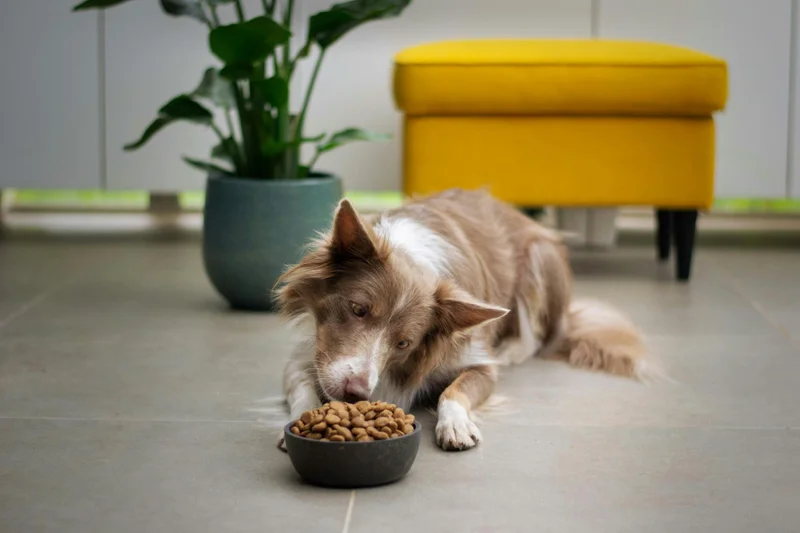
Dog Elimination Diet: An 8-12 Week Owner's Guide
An owner's walk-through of the elimination diet — what your vet may recommend, the 8-12 week protocol they'll commonly outline, and the mistakes that wreck a trial.
Dog's Paws Itchy After Eating? What to Look For
When a dog's paws get itchy specifically after meals, food allergy is the leading suspect. The signs that point to food, and what to investigate next.
Seasonal vs Food Allergies in Dogs: How to Tell the Difference
Learn how to distinguish seasonal from food allergies in dogs. Covers timing patterns, symptom differences, diagnostic testing, and treatment approaches.
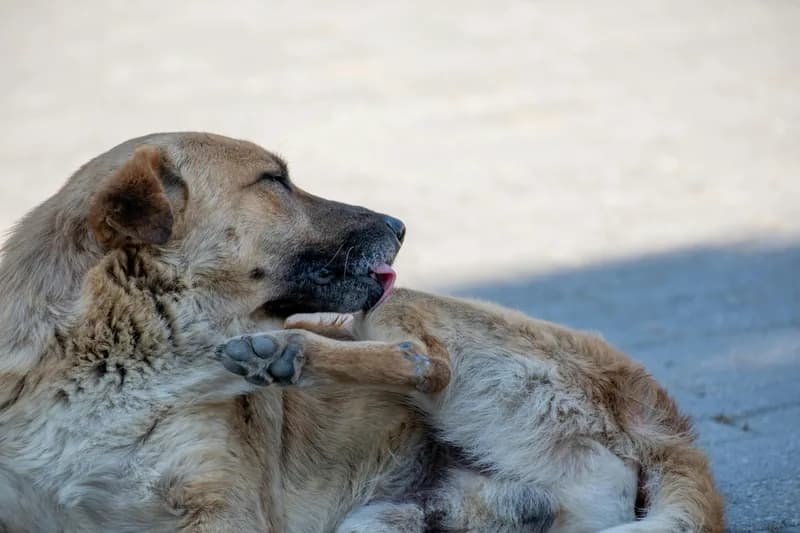
Why Is My Dog Licking Their Paws? Complete Guide
Why dogs lick their paws excessively covering allergies as the top cause, food vs environmental triggers, brown saliva staining, and treatment options.
Cite this article
Gary Innes. (2026). Dog Licking Between Their Toes: Causes and What to Do. Pet Allergy Scanner. Retrieved 2026-07-06T22:16:44.000Z from https://petallergyscanner.com/blog/dog-licking-paws-between-toes/
For other citation styles or to embed our tools, see the press & citations page.
About the author — Gary Innes
Gary is a UK pet owner who built Pet Allergy Scanner after 7+ years navigating his Cockapoo's chronic food allergy — a dog whose safe diet has narrowed to salmon, venison and vegetables. He is not a veterinarian and has no veterinary or nutrition qualifications. Every article on the site is owner-to-owner research that cites primary veterinary sources (Mueller et al. BMC Vet Res 2016, ACVD, Merck Vet Manual) and defers diagnostic and treatment decisions to a vet.
Read more about Pet Allergy Scanner's editorial standards →